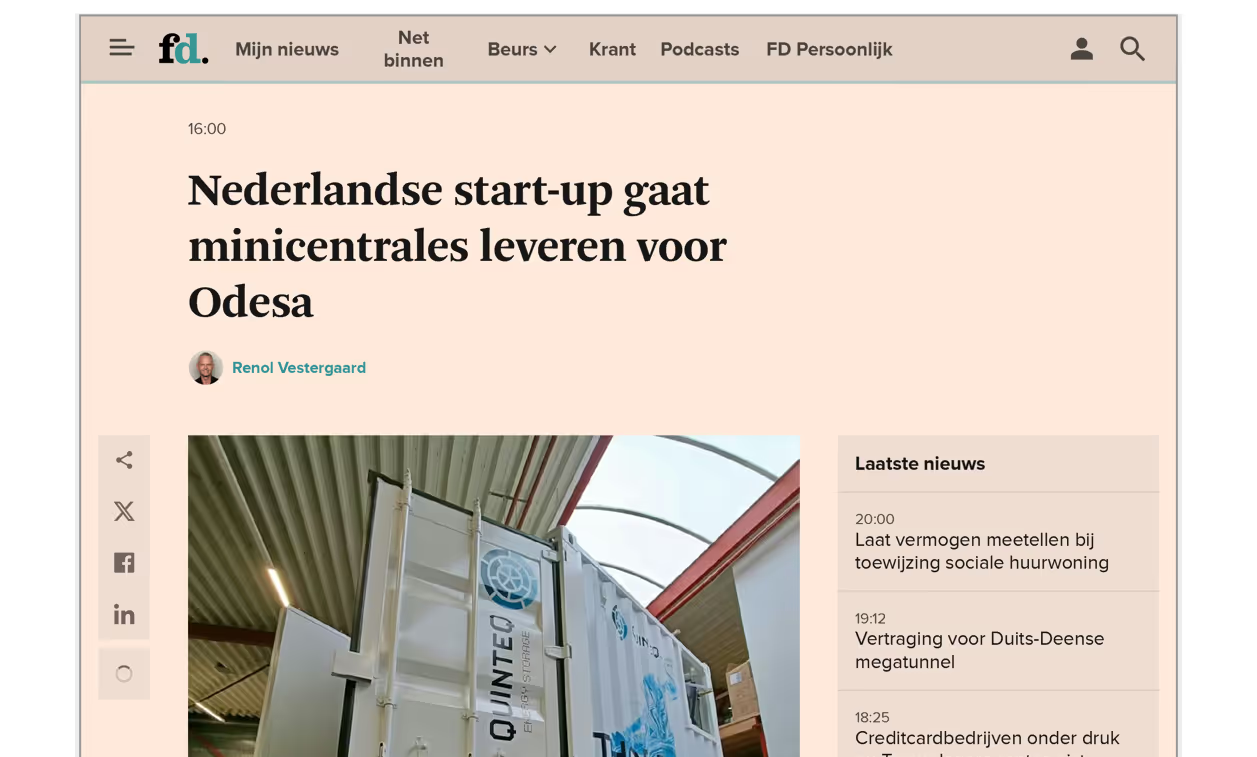
Het Financieele Dagblad: QuinteQ to supply mini power plants to Odesa
We're proud to share this article from Het Financieele Dagblad, written by Renol Vestergaard, detailing our agreement with the Dutch Ministry of Economic Affairs and the Lockheed Martin Corporation to supply Ukraine's Odesa port with our flywheel systems. Check out the version in English below, or read the original Dutch version either here or at the original link.
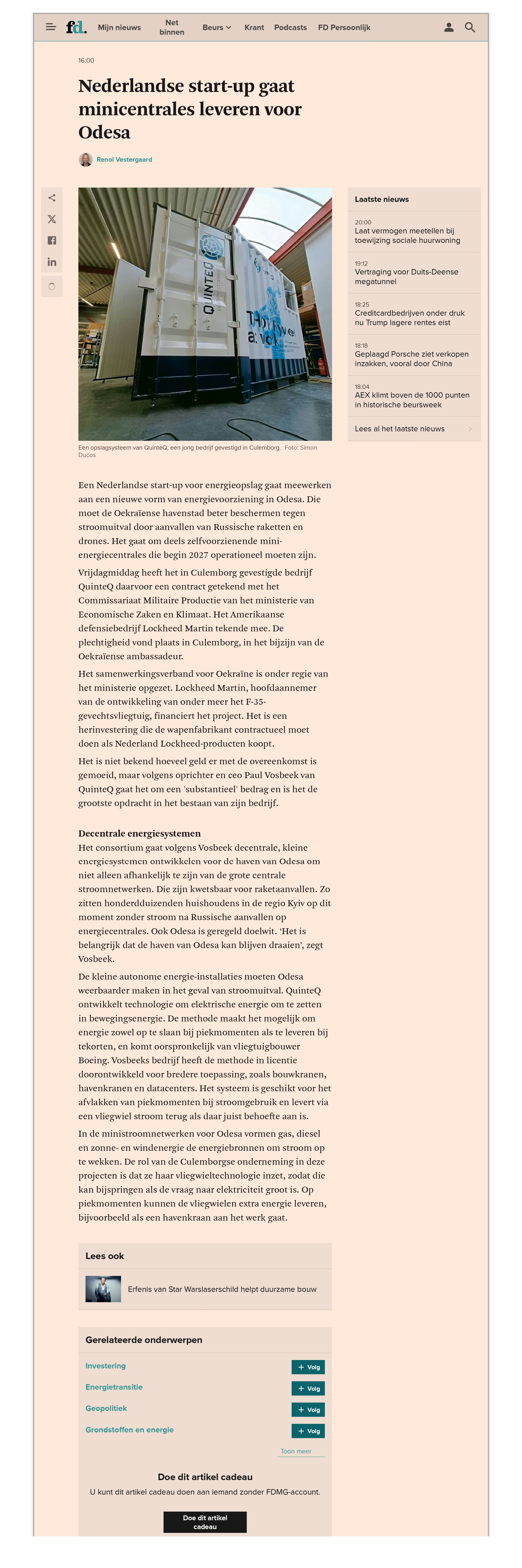
Dutch start-up to supply mini power plants for Odesa
By Renol Vestergaard
A Dutch energy storage start-up is going to collaborate on anew form of energy supply in Odessa. This should better protect the Ukrainian port city against power outages caused by Russian missile and drone attacks. It involves partially self-sufficient mini power plants that are expected to be operational in early 2027.
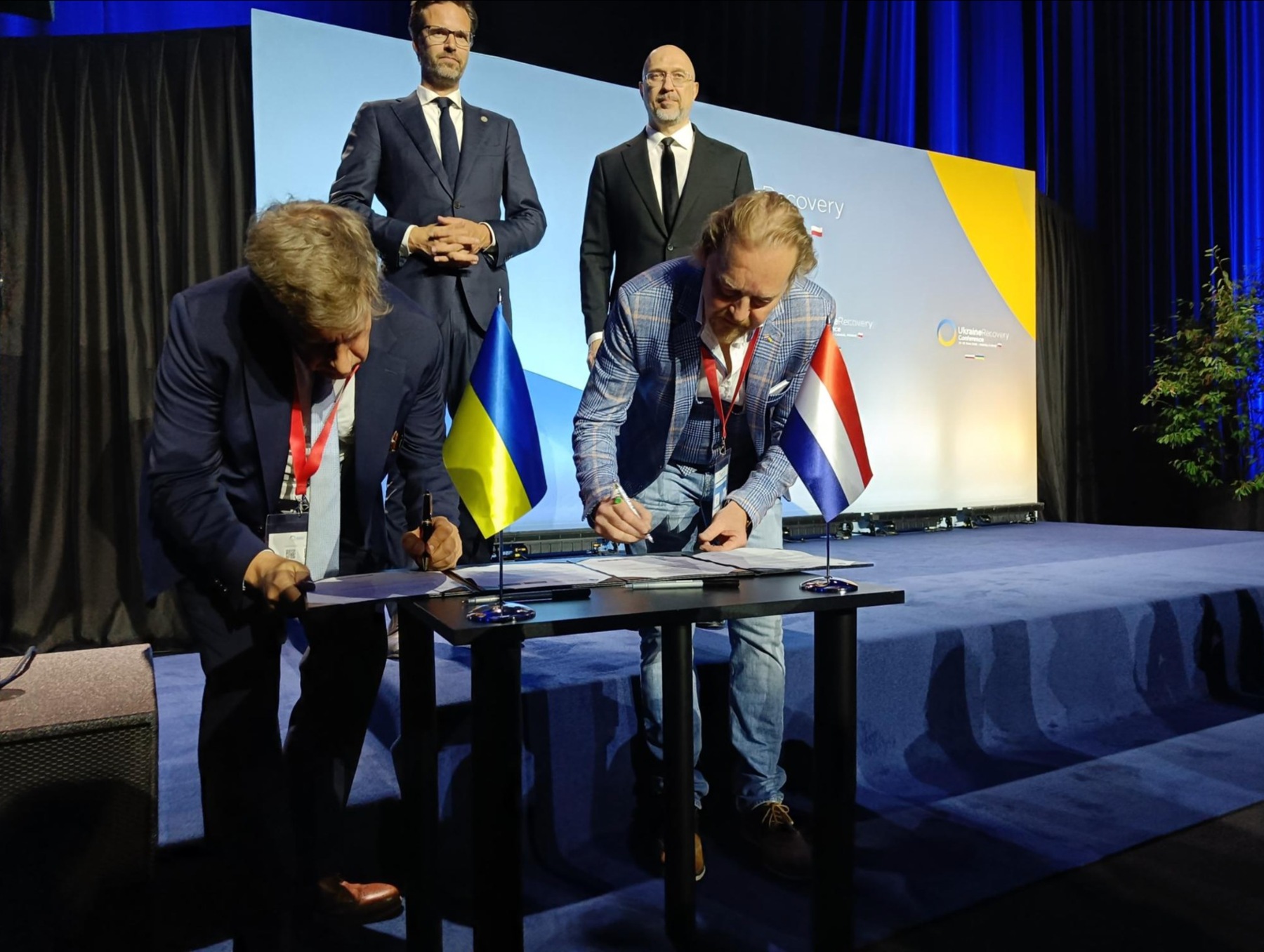
On Friday afternoon, Culemborg-based company QuinteQ signed a contract for this with the Military Production Commission of the Ministry of Economic Affairs and Climate Policy. The American defense company Lockheed Martin also signed. The ceremony took place in Culemborg, in the presence of the Ukrainian ambassador.
The partnership for Ukraine was set up under the direction of the ministry.Lockheed Martin, the main contractor for the development of the F-35 fighter jet, among other things, is financing the project. It is a reinvestment that the arms manufacturer is contractually obliged to make when the Netherlands purchases Lockheed products.
It is not known how much money is involved in the agreement, but according to QuinteQ founder and CEO Paul Vosbeek, it is a “substantial” amount and is the largest contract in his company's history.
Decentralized energy systems
According to Vosbeek, the consortium will develop decentralized, small-scale energy systems for the port of Odessa so that it is not solely dependent on the large central power grids. These are vulnerable to missile attacks. Hundreds of thousands of households in the Kyiv region are currently without power following Russian attacks on power stations. Odessa is also a regular target.“It is important that the port of Odessa can continue to operate,” says Vosbeek.
The small autonomous energy installations should make Odessa more resilient in the event of a power outage. QuinteQ develops technology to convert electrical energy into kinetic energy. The method makes it possible to store energy at peak times and supply it during shortages, and was originally developed by aircraft manufacturer Boeing. Vosbeek's company has further developed the method under license for broader application, such as construction cranes, port cranes, and data centers. The system is suitable for smoothing out peak moments in power consumption and, via a flywheel, supplies power back when it is needed.
In the mini power grids for Odessa, gas, diesel, solar, and wind energy are the sources used to generate electricity. The role of the Culemborg-based company in these projects is to deploy its flywheel technology so that it can step in when demand for electricity is high. At peak times, the flywheels can supply extra energy, for example when a harbor crane is in operation.