QuinteQ featured in Link Magazine : “With a flywheel, you can absorb 80% of peak loads.”
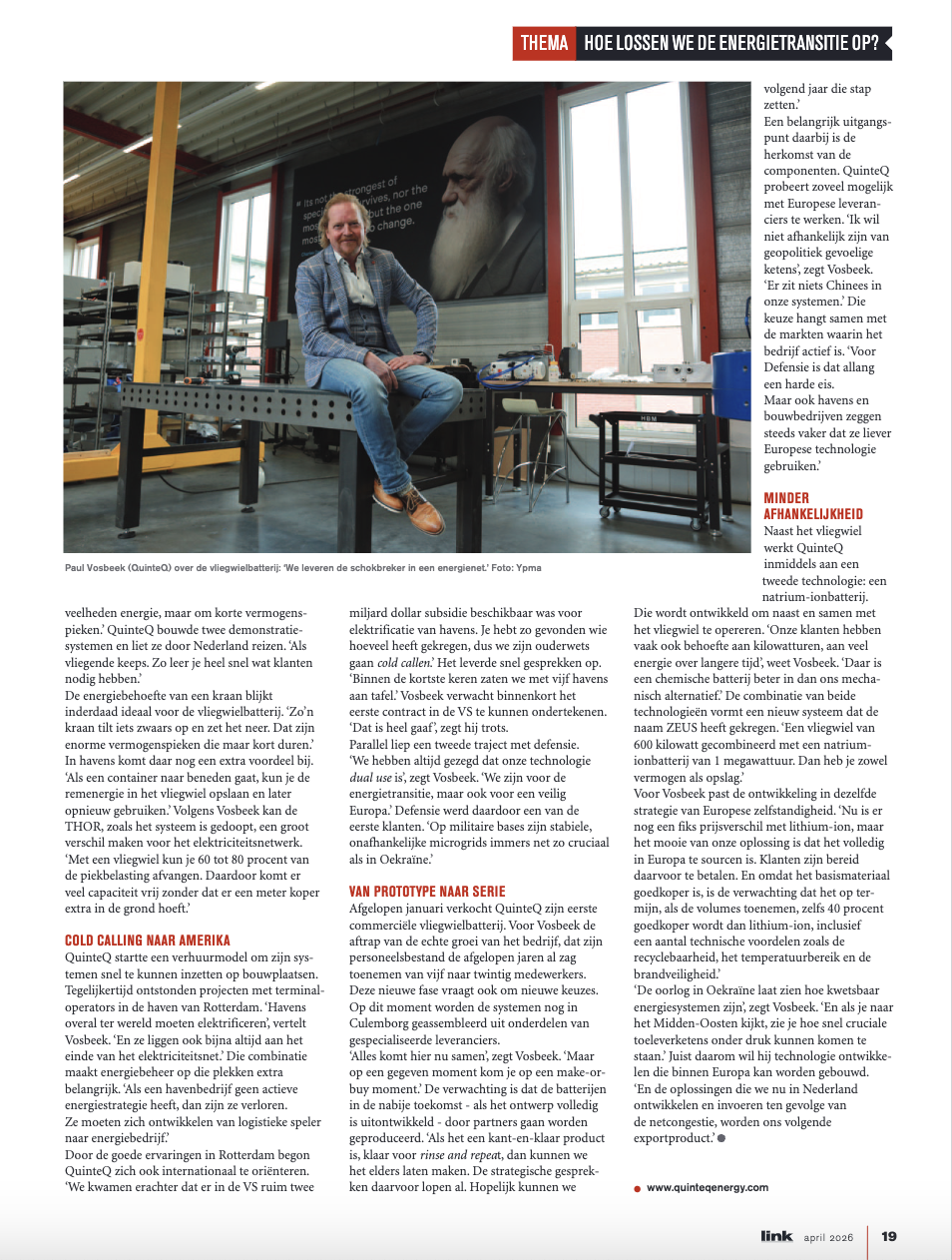
QuinteQ from Culemborg builds mechanical batteries
“With a flywheel, you can absorb 80 percent of peak load”
What began as aerospace technology from Boeing has now found its way, through QuinteQ, to construction sites, ports and even Ukraine. The Culemborg-based company builds mechanical batteries using flywheels that can absorb power peaks where chemical batteries fall short. Grid congestion, electrification and geopolitical developments are now coming together at exactly the right moment.
By Alexander Pil
During his first night in Kyiv, Paul Vosbeek woke up to a piercing alarm on his phone. An app warned him that missiles or drones were on their way, giving him only a few minutes to get to the shelter. He then spent hours waiting with dozens of others until the air raid alert was lifted.
“On one of the nights I was there, three drones were destroyed and seventy rockets were fired at Kyiv,” Vosbeek says. “That is when you really realise: this is war, less than three hours by plane from the Netherlands.”
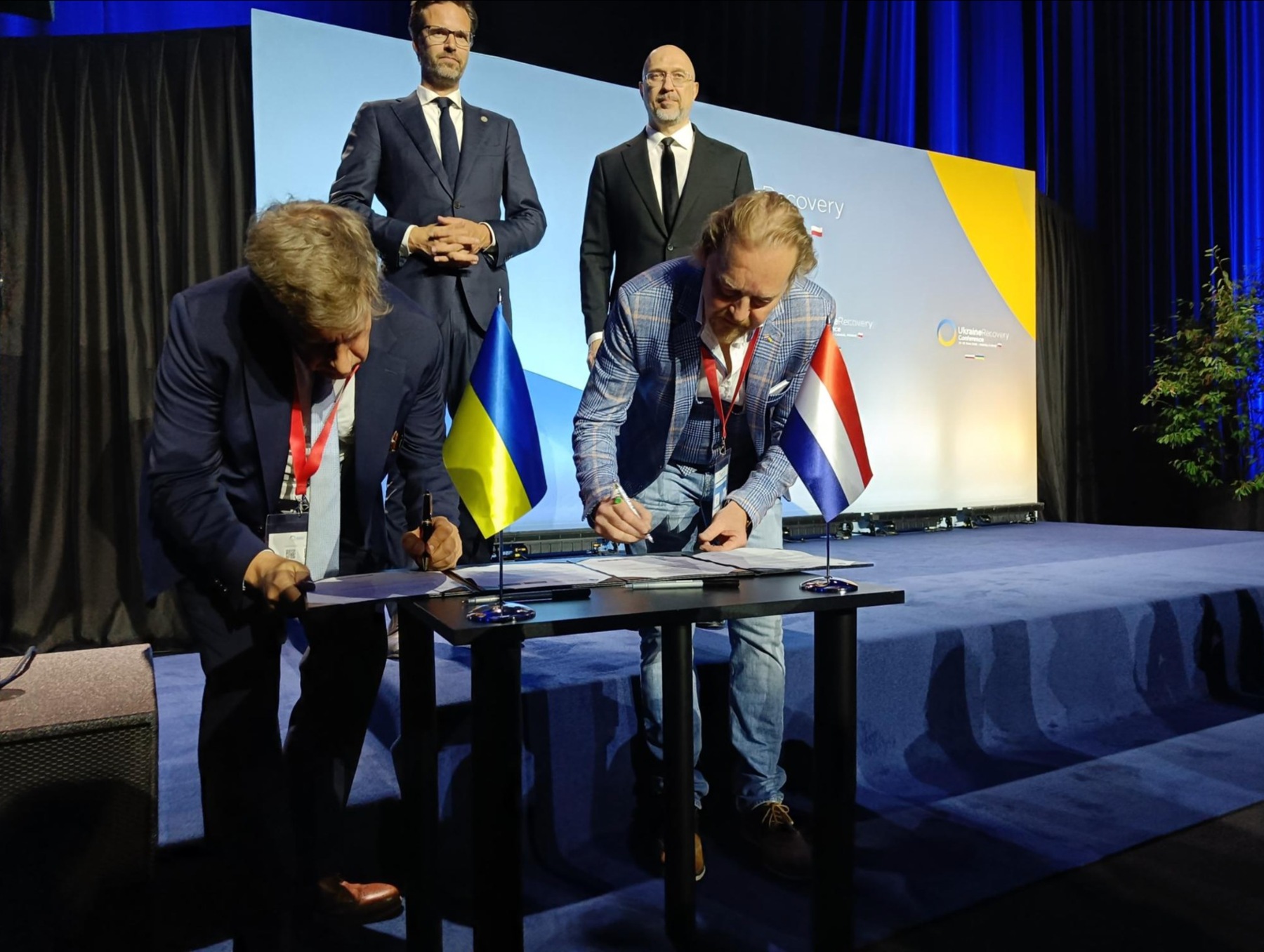
Vosbeek travelled to Ukraine that year because his company, QuinteQ, was involved in building a microgrid in the port of Odesa. The system is designed to keep electricity running while the central energy infrastructure is under constant attack.
“Eighty percent of Ukraine’s central energy generation has been damaged or destroyed,” he says. “So you need to build a robust energy system that is not dependent on one large grid.”
For Vosbeek, the visit confirmed the direction his company had taken in recent years. “What we are building is exactly what they need there,” he says. “Decentralised energy networks that keep operating, even when the rest fails.”
In Odesa, a 3.6-megawatt microgrid is being built, integrating QuinteQ’s flywheel batteries from Culemborg. Vosbeek calls it, with a smile, a “mic drop moment” for mission-driven QuinteQ: “We have a solution for the energy transition, and we are applying it in Ukraine.”
From Boeing to Culemborg
QuinteQ’s technology is a mechanical battery based on a flywheel, which can absorb large power peaks and stabilise the grid.
“We provide the shock absorber in an energy network,” Vosbeek explains.
The system converts electricity into kinetic energy in a rapidly spinning flywheel, and can then release that energy quickly with significantly less loss than traditional batteries. Because the flywheel rotates in a vacuum chamber and uses special low-friction bearings, very little energy is lost. Efficiency lies between 80 and 90 percent.
And because the energy scales linearly with mass and quadratically with rotational speed, a relatively small, fast-spinning wheel can store a large amount of energy.
The flywheel battery did not originate in Culemborg, but at Boeing. The American aerospace company worked on the technology for more than ten years for space applications. However, after urgent issues arose with the Dreamliner, development came to a halt and the flywheel technology was left on the shelf.
Together with his business partner Wouter Biemans, Vosbeek saw an opportunity.
“We obtained a worldwide exclusive licence, including two hundred patents and two thousand drawings, calculations and reports. Around twenty million dollars had already been invested and several prototypes had been built. It was incredibly high-quality technology, but there was not yet a clear market.”
500,000 cycles
Back in the Netherlands, the two started again in 2019.
“Wouter is deeply technical; he studied aerospace engineering in Delft. I come from a business and economic background. That makes us a good team,” says Vosbeek.
The first step was redeveloping the system.
“The Boeing system delivered five kilowatts. It was space-grade technology: extremely efficient, with superconducting bearings, but also extremely expensive. It would never fit the applications we had in mind. So we started two tracks at the same time: further developing the technology and exploring the market.”
For the development, QuinteQ received support from Thales, Saxion University of Applied Sciences and the University of Twente. In an EU-funded consortium, the power was increased first to 300 kilowatts and later to 600 kilowatts, for a system that fits inside a 10-foot container.
Vosbeek stresses that the flywheel solution has completely different characteristics from traditional chemical batteries.
“First of all, a normal battery can be charged and discharged maybe 5,000 times. Our flywheel can easily go through 500,000 cycles. And during use, there is no degradation, so performance remains stable. Wear parts can also simply be replaced.”
The crane as a demonstration case
Those characteristics match the needs of a microgrid, but the real breakthrough only came when grid congestion became a major topic in the Netherlands.
“Construction companies are now often given temporary grid connections that do not provide enough power to run their cranes. We realised that the energy profile of our flywheel fits perfectly,” says Vosbeek.
“It is not about large amounts of energy, but about short power peaks.”
QuinteQ built two demonstration systems and toured them around the Netherlands.
“We let the demonstration systems travel through the country. That allowed everyone to see what they could do.”
The energy demand of a crane turned out to be ideal for the flywheel battery.
“A crane lifts a heavy load and then lowers it again. That creates enormous power peaks, but they only last for a short time. In ports, there is an additional benefit: when a container is lowered, the energy can be stored in the flywheel and reused later.”
According to Vosbeek, THOR-X, as the system is called, can make a major difference to the electricity grid.
“With a flywheel, you can absorb 60 to 80 percent of peak load. That frees up a lot of capacity without having to put another metre of copper into the ground.”
Cold calling America
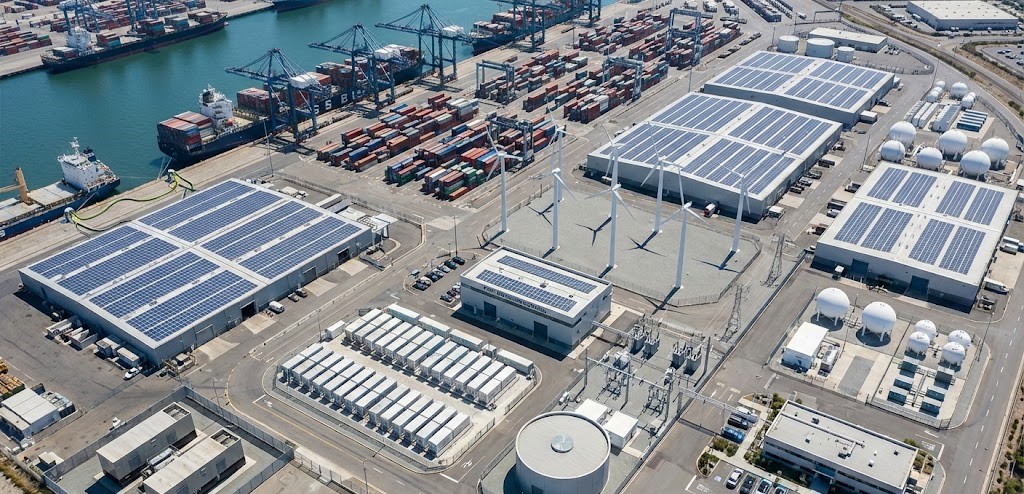
QuinteQ started with a rental model to make its systems available quickly on construction sites. At the same time, projects with terminal operators in the Port of Rotterdam began to emerge.
“Ports all over the world need to electrify,” Vosbeek says. “And almost all of them are running up against the limits of the electricity grid. That combination makes energy management during peaks especially important. If a port company does not have an active energy strategy, it will lose out. They need to evolve from logistics players into energy companies.”
Thanks to the positive experience in Rotterdam, QuinteQ also began exploring international opportunities.
“We discovered that in the United States, more than two billion dollars in subsidies were available for the electrification of ports. You saw how much funding had been allocated there, so we did things the old-fashioned way and started cold calling. That quickly led to conversations. Within a very short time, we were at the table with five ports.”
Vosbeek expects the first contract in the US to be signed this year.
“That is incredible,” he says proudly.
In parallel, a second track is developing with defence.
“We have always said that our technology is dual-use,” Vosbeek says. “We are here for the energy transition, but also for a secure Europe.”
As a result, defence became one of the first customers.
“At military bases, stable, independent microgrids are just as crucial as they are in Ukraine.”
From prototype to series production
Last January, QuinteQ sold its first commercial flywheel battery. For Vosbeek, it marked the end of an intense growth phase in which the company’s team expanded from five to twenty employees over the past few years.
This new phase also brings new decisions. At the moment, the systems are still assembled in Culemborg using components from specialised suppliers.
“Everything comes together here,” says Vosbeek. “But at some point, we will reach a make-or-buy moment. The expectation is that, once the design is fully developed, the batteries will eventually be produced by partners. Once it becomes a true end product, ready for rinse and repeat, we can have it manufactured elsewhere. Strategic discussions about this are already underway. Hopefully, we can take that step next year.”
An important principle in this process is the origin of the components. QuinteQ tries to work with European suppliers as much as possible.
“I do not want to depend on geopolitically sensitive supply chains,” Vosbeek says. “There is nothing Chinese in our systems.”
That choice is closely linked to the markets in which the company operates.
“For defence, that has long been a strict requirement. But ports and construction companies are also increasingly saying that they prefer to use European technology.”
Less dependency
In addition to flywheel technology, QuinteQ is now also working on a second technology: a sodium-ion battery. This is being developed alongside, and in combination with, the flywheel.
“Our customers often also need kilowatt-hours — a lot of energy over a longer period of time,” Vosbeek explains. “In that case, a chemical battery can sometimes be a better fit than our mechanical alternative.”
The combination of both technologies forms a new system called ZEUS: a 600-kilowatt flywheel combined with a one-megawatt sodium-ion battery. This provides both power and storage.
For Vosbeek, this development fits within the same strategy of European self-sufficiency.
“With lithium-ion, it is still quite theoretical, but the great thing about our solution is that it can be sourced entirely in Europe. Customers are willing to pay for that. And because the base material is cheaper, the expectation is that, as volumes increase, it will eventually become around 40 percent cheaper than lithium-ion, while also offering several technical advantages such as recyclability, temperature range and fire safety.”
“The war in Ukraine shows how vulnerable energy systems are,” Vosbeek says. “And if you look at the Middle East, you see how quickly critical supply chains can come under pressure. That is exactly why technology that can be developed within Europe is becoming so important.”
“And the solutions we are now developing in the Netherlands and rolling out across Europe in response to grid congestion will become our next export product.”